
FAQs Answers
A forensic knowledge base for the modern kitchen. From the chemical mechanics of oil degradation to the thermal destruction of pathogens, we provide evidence-based data for 5-star compliance.
01. Foundational Logic
Food Safety describes the handling, preparation, and storage of food in a way that best reduces the risk of individuals becoming sick from foodborne illnesses. Within the HFS Master Blueprint, this is not merely a set of rules but a scientific system designed to prevent the proliferation of pathogenic microorganisms at every step of the supply chain, protecting both consumer health and business longevity.
We categorize hazards into four distinct forensic streams. Identifying these hazards is the first step in any robust Hazard Analysis and Critical Control Point (HACCP) system:
- Biological: Pathogenic bacteria (e.g., Salmonella), viruses (e.g., Norovirus), and parasites that contaminate food via raw materials or poor handling.
- Chemical: Cleaning agents, pesticides, and toxins naturally produced by specific fish (e.g., Histamine) or fungi (e.g., Mycotoxins).
- Physical: Foreign objects such as glass, metal shards from equipment, or jewelry that pose a choking or injury risk.
- Allergenic: Cross-contamination with the 14 major allergens (e.g., Gluten, Peanuts, Shellfish) that can cause life-threatening reactions in sensitive individuals.
02. Forensic Microbiology
A Foodborne Infection occurs when you ingest live pathogens like Salmonella enterica or Campylobacter jejuni, which then colonize your gut. This usually has a long “Lag Phase” of 12–72 hours as the bacteria multiply inside the host.
A Foodborne Intoxication occurs when bacteria like Staphylococcus aureus or Bacillus cereus grow in the food and produce heat-stable toxins. Even if you cook the food and kill the bacteria, the toxin remains active. Symptoms are often violent and manifest within 1–6 hours. This is why temperature abuse during prep cannot be “fixed” by subsequent cooking; the damage is chemical, not just biological.
Unlike most foodborne pathogens that go dormant at low temperatures, Listeria monocytogenes is psychrotrophic, meaning it can continue to grow at refrigeration temperatures (below 5°C). This makes it a primary hazard for ready-to-eat (RTE) chilled foods such as deli meats and salads. Controlling it requires a forensic approach to sanitisation of cold-storage environments and strict shelf-life management.
The value of pH 4.6 is the forensic limit for the growth of Clostridium botulinum. In environments with a pH below 4.6 (high acid), the spores are inhibited and cannot produce the lethal neurotoxin. This scientific benchmark governs all canning, pickling, and artisanal oil infusion standards. If your product is “low-acid” (pH above 4.6), it must be pressure canned or refrigerated to prevent botulism.
Water Activity ($a_w$) is the measure of “available” water for bacteria to use. Most pathogens require an $a_w$ of 0.95 or higher to multiply. By adding salt or sugar (which “binds” the water) or through dehydration, we can make a product shelf-stable even if it looks “moist.” This is the foundational science behind curing meats, making preserves, and high-sugar confections.
The Lag Phase is the initial period where bacteria are adapting to their environment before they begin rapid, exponential growth. By prepping in small batches and returning food to the fridge within 20 minutes, you effectively “reset” or significantly delay the transition to the Log Phase (rapid multiplication). This proactive batch-management keeps the microbial population at safe, manageable levels.
03. Thermal Controls
In a professional kitchen, the Danger Zone is the temperature range between 5°C and 63°C. In this range, bacteria such as Escherichia coli and Salmonella enterica multiply rapidly. To prevent population explosions, food must pass through this zone as quickly as possible during both the heating and cooling cycles of production.
The target of 75°C (or 70°C for 2 minutes) is a scientific benchmark designed to achieve a 6-log reduction in pathogens. This mathematical reduction ensures that 99.9999% of vegetative cells are destroyed. While higher temperatures may affect texture, 75°C remains the gold standard for rendering high-risk proteins safe for consumption in a commercial environment.
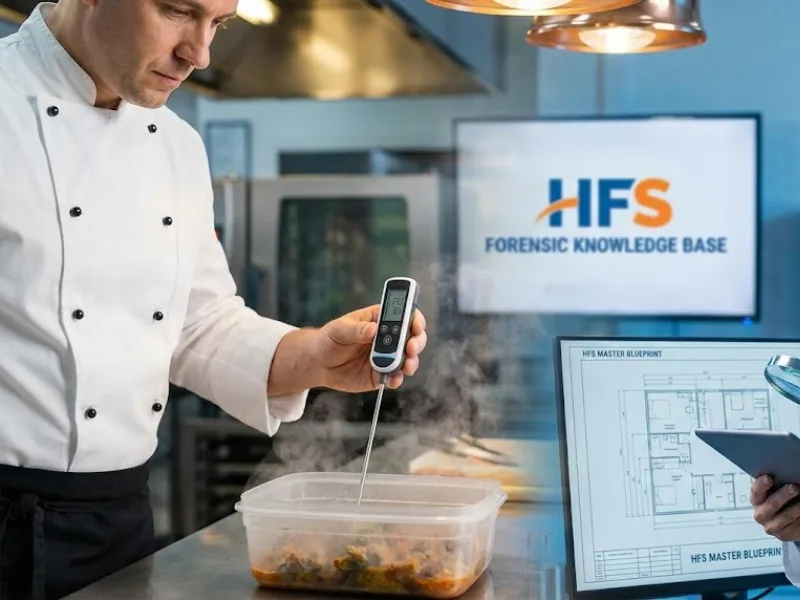
To maintain an audit-proof system, digital thermometers should undergo a weekly verification check using the Ice-Point Method. Create a slurry of crushed ice and water. Immerse the probe tip. It should read exactly 0°C (±0.5°C). While boiling water is acceptable, you must account for atmospheric pressure; at higher elevations, water boils at lower temperatures, which can lead to false calibration data if not adjusted.
Sous vide (low-temperature, long-time cooking) is safe only if the Thermal Death Time (TDT) is calculated correctly for the specific protein. Because the food is vacuum-sealed, there is a high risk of anaerobic growth from Clostridium botulinum if temperatures are held too low. Forensic compliance requires a dedicated Sous Vide log tracking water bath stability and using needle-probe core temperatures through foam tape.
04. Operational Hygiene
Any food handler suffering from vomiting or diarrhea must be excluded from the kitchen for a minimum of 48 hours after their symptoms have completely ceased. This is a critical barrier against the transmission of Norovirus. Many viral pathogens continue to shed in high volumes long after the individual feels healthy, making early return a catastrophic outbreak risk.
A biofilm is a microscopic fortress built by bacteria like Pseudomonas or Listeria. They secrete a sticky extracellular matrix that shields the colony from chemical sanitisers. Forensic cleaning requires mechanical friction (scrubbing) to physically break the matrix before the sanitiser can reach and destroy the bacterial cell wall.
Gloves often provide a False Security. Bacteria like Staphylococcus aureus can multiply rapidly in the warm, moist environment inside a glove. The HFS standard prioritizes frequent handwashing using the forensic 6-step technique. Gloves should only be used as a secondary barrier for high-risk ready-to-eat (RTE) tasks and must be changed as often as bare hands should be washed.
TPHC allows food to be held in the Danger Zone for a strictly limited duration—usually 4 hours for hot food or 2 hours for cold food—before mandatory disposal. This is only legally valid if start and end times are documented and the food is never returned to refrigeration. It is a control measure for buffets and rapid-service environments.
05. Audit & Legal Intelligence
Due Diligence is the only legal defense against a food safety prosecution. It requires the business to prove in court that it took “all reasonable precautions” to prevent a failure. This is achieved through a validated HACCP plan, a fully trained brigade, and verified records (like your HFS Calibration Log) that prove your system was functioning at the forensic level during the time of an incident.
A Use-By date is a safety deadline. Past this date, pathogens like Listeria monocytogenes may reach infectious levels even if the food looks and smells normal. It is a criminal offense to serve food past this date. A Best Before date is merely a quality indicator; the food remains safe, but its texture and flavor profile have degraded.
Recording a failure (e.g., a fridge at 10°C) without a documented solution is a critical audit non-conformance. A Corrective Action is the evidence of your professional fix: “Fridge found at 10°C. Stock moved to walk-in chiller. Engineer called. Stock core-temped at 3°C (Safe).”
Technical Query Unresolved?
Our forensic consultants provide deep-tier auditing for complex manufacturing and catering operations.
Contact the Forensic Lab