
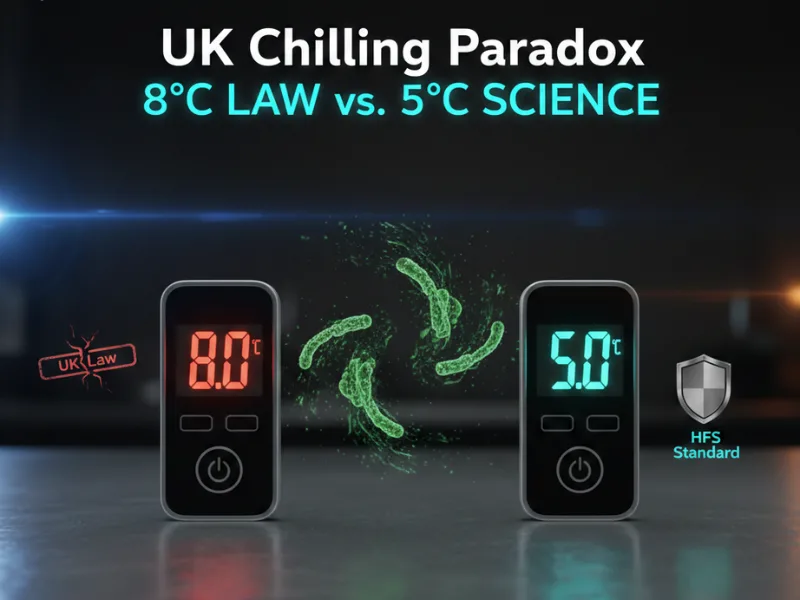
In the professional UK kitchen environment, “compliance” is often misinterpreted as a final destination. For many food handlers, reaching the legal minimum is considered a job well done. However, at Hygiene Food Safety, we operate on a more robust frequency. We acknowledge that while the UK legal limit provides the framework for staying out of court, only microbiological science provides the framework for staying out of a crisis. This article deconstructs the paradox of the 8°C legal threshold and why your team must aim for the 5°C scientific standard to be truly “Hygienic.”
The Statutory Floor: Understanding the 8°C Requirement
In England, Wales, and Northern Ireland, the primary legislation governing chilled food storage is found within the Food Hygiene (England) Regulations 2006 (and subsequent updates). The law is explicit: any high-risk food that supports the growth of pathogenic microorganisms or the formation of toxins must be maintained at a temperature of 8°C or below.
From a regulatory standpoint, this is a binary system. If an Environmental Health Officer (EHO) probes your cooked chicken and records 7.9°C, you are technically compliant. You have met the statutory requirement. However, this legal baseline was established as a pragmatic compromise between the physics of industrial refrigeration and the public health baseline. It is not, and was never intended to be, a target for total microbiological stasis.
The Microbiological Conflict: Silent Proliferation
The conflict arises when we analyse the behaviour of psychotropic (cold-loving) bacteria. While the law permits 8°C, science warns that this temperature sits uncomfortably deep within the “Danger Zone” for several dangerous pathogens. The most notable of these is Listeria monocytogenes.
The Listeria monocytogenes Exception
Listeria is the ghost in the machine of cold storage. Unlike Salmonella, which is significantly inhibited at chill temperatures, Listeria is uniquely adapted to survive and slowly multiply in cold environments. At the legal UK limit of 8°C, Listeria populations can double their numbers twice as fast as they would at 5°C. For a team managing “Ready-to-Eat” (RTE) foods—which require no further cooking to kill bacteria—this doubling rate is the difference between a safe product and a contaminated one.
3.0 The HFS Strategy: Acknowledge the Law, Command the Science
To be robust for an EHO inspection while remaining scientifically safe, Hygiene Food Safety recommends a “Two-Tier” recording strategy. We must train food handlers to acknowledge the law while bearing in mind the microbiological consequences of higher temperatures.
| THERMAL ZONE | LEGAL STATUS (UK) | MICROBIOLOGICAL OUTCOME | HFS PROTOCOL |
|---|---|---|---|
| 0°C to 5.0°C | Compliant | Maximum stasis; pathogensis inhibited. | OPTIMAL |
| 5.1°C to 8.0°C | Compliant | Slow bacterial growth; reduced shelf life. | INVESTIGATE |
| 8.1°C + | ILLEGAL | Rapid proliferation; Danger Zone entry. | CRITICAL FAILURE |
The “Core vs Air” Technical Failure
Most commercial fridges in the UK utilize an external digital display. A critical misunderstanding among food handlers is that this display represents the temperature of the food. In reality, it represents the air temperature near the sensor. Air recovers quickly, but food—due to its density—takes much longer to cool back down once it has warmed up. If your air display reads 8°C, the core of your high-risk ingredients may actually be hovering at 9°C or 10°C, putting you in a state of “unintentional non-compliance.”
Implementing Simulant Probing
To master the 2026 Master Blueprint, we recommend using a “Simulant Probe.” This is a permanent container of water or gel kept in the fridge that you probe for your daily logs. This reflects the actual microbiological state of your ingredients rather than the volatile air around them. This level of detail is exactly what earns a “Confidence in Management” score from an EHO.
Professionalism Over Permission
UK Food Safety Law permits you to operate at 8°C, but microbiological best practice requires you to target 5°C. By acknowledging the legal limits while bearing in mind the microbiological consequences, your team moves from being “compliant” to being “elite.” This protects your customers from Listeria, protects your business from EHO enforcement, and protects your reputation from the “silent proliferation” of bacteria.